
 Wildlife
of USA
Lincoln's Sparrow
Sparrows, Buntings & Finches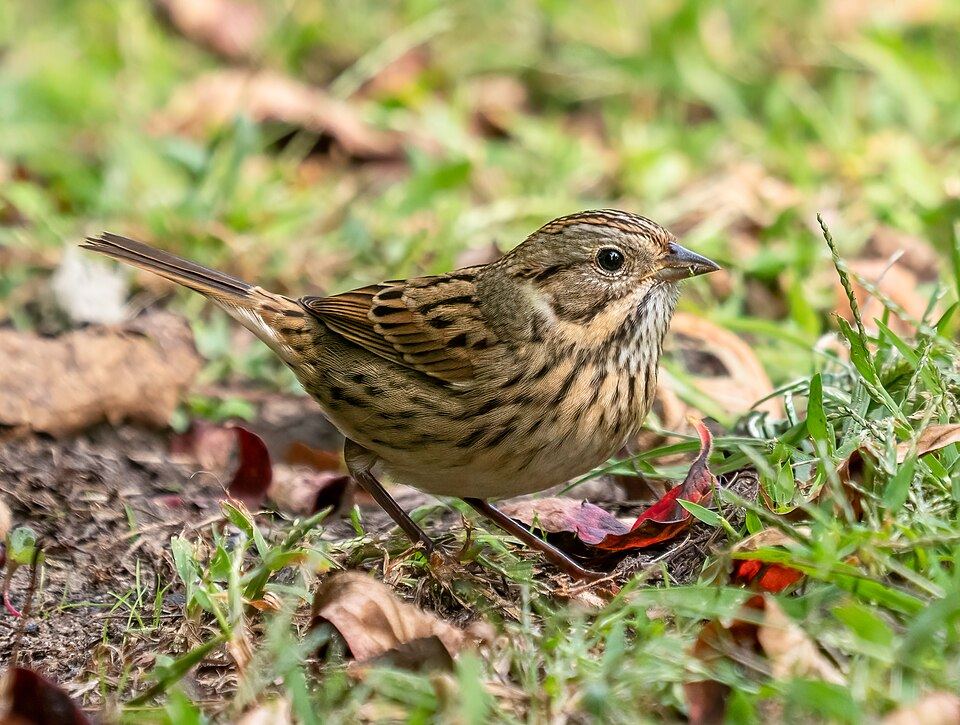
Photo: Rhododendrites · CC BY-SA 4.0 (May be cropped or resized)
Melospiza lincolnii
U.S. national list: unknown
Basic stats
Habitat
Wetland
Range
Alaska and Canada through the United States to Mexico and northern Central America
Clutch size
3–5 eggs
Incubation period
12–14 days
Weight
17g
Lincoln's Sparrow has olive-brown upperparts marked with dark streaks, a finely streaked light-brown breast, white belly and throat, and a grey face with brown cheeks. A brown cap is divided by a grey central stripe, and the narrow tail gives it a trim appearance. AVONET records an average mass of 17 g and mean wing length of 64 mm. Its calls include a flat chip and a high buzzy zeet, with a hoarse zrrr sequence used in social contexts (AVONET, Tobias et al. 2022; Wikipedia, general species account).
Breeding habitat includes wet thickets, shrubby bogs, mossy areas, willow cover, and montane or subalpine zones. Nests are shallow open cups concealed on the ground beneath grass or shrubs. The winter range extends from the southern United States to Mexico and northern Central America. Birds forage mainly on the ground; winter food is largely seeds, while breeding-season feeding emphasizes arthropods. Clutches typically contain three to five eggs, incubated for about 12–14 days (Wikipedia, general species account).
Where to see Lincoln's Sparrow in the USA
GBIF records grouped by protected area. They show where the species has been reported, not that it is there now, and they are not population counts.
Recorded in 5,299 protected areas (1884–2026). The 8 with the most records:
- Coronado National Forest: 23,511 records (1931–2026)
- Estero Llano Grande State Park: 8,659 records (2000–2026)
- Patagonia-Sonoita Creek Preserve: 8,401 records (1972–2025)
- American River Parkway: 7,608 records (1974–2026)
- Monterey Bay National Marine Sanctuary: 7,327 records (1918–2026)
- San Pedro Riparian National Conservation Area: 7,184 records (1913–2025)
- Rocky Mountain National Park: 6,175 records (1956–2026)
- Wasatch–Cache National Forest: 5,391 records (1913–2026)
Quick answers
- What habitat does the Lincoln's Sparrow live in?
- Wetland
- Where is the Lincoln's Sparrow found?
- Alaska and Canada through the United States to Mexico and northern Central America
- How many eggs does the Lincoln's Sparrow lay?
- 3–5 eggs
- How long are the eggs of the Lincoln's Sparrow incubated?
- 12–14 days
- How much does the Lincoln's Sparrow weigh?
- 17g