
 Wildlife
of USA
Black Swan
Waterfowl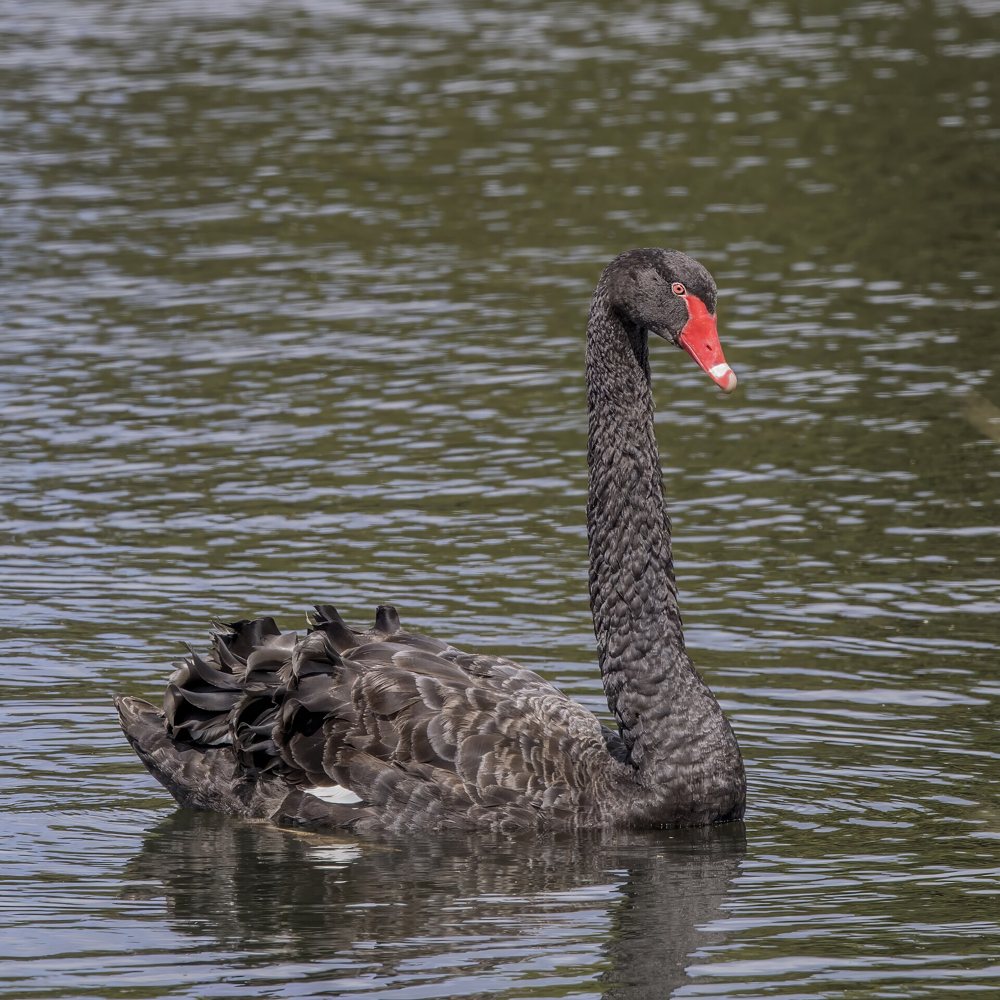
Photo: Charles J. Sharp · CC BY-SA 4.0 (May be cropped or resized)
Cygnus atratus
U.S. national list: unknown
Basic stats
Diet
Aquatic and other plant material
Habitat
Lakes, swamps, rivers, flooded fields and sheltered coasts
Range
Native to Australia; established populations occur in New Zealand and elsewhere
Size
110–142cm
Wingspan
160–200cm
Weight
Averages about 5623g
The Black Swan is a large waterbird, 110–142 cm long with a 160–200 cm wingspan and an average mass near 5,623 g. Black body plumage conceals white flight feathers visible in the open wing, while the bill is bright red with a pale band and tip. Males average slightly larger than females; cygnets are grey-brown (Wikipedia, general species account; AVONET, Tobias et al. 2022).
Native across Australian wetlands, the species uses fresh, brackish and saline lakes, swamps, rivers, flooded grassland, tidal flats and sheltered coastal water. It moves nomadically in response to rainfall and drought rather than following a fixed migration. Aquatic and emergent vegetation supply both food and nesting material, and plant matter comprises the entire EltonTraits diet profile. Both parents incubate and tend the young (Wikipedia, general species account; EltonTraits, Wilman et al. 2014).
Records of Black Swan in the USA
This bird's natural range lies outside the USA (AviList v2026), so these are records of wandering, escaped or introduced birds, not places to expect it.
GBIF records grouped by protected area. They show where the species has been reported, not that it is there now, and they are not population counts.
Recorded in 45 protected areas (1975–2024). The 8 with the most records:
- Tualatin River National Wildlife Refuge: 628 records (2023–2024)
- Cape May Point State Park: 311 records (2014–2016)
- Bombay Hook National Wildlife Refuge: 151 records (1981–2024)
- Wapato Lake National Wildlife Refuge: 47 records (2024)
- Butner-Falls of Neuse Game Land: 44 records (2023)
- Cuba Marsh Forest Preserve: 28 records (2020)
- Wayne National Forest - Marietta Unit: 27 records (2023–2024)
- Minnesota Valley National Wildlife Refuge: 23 records (2016)
Quick answers
- What does the Black Swan eat?
- Aquatic and other plant material
- What habitat does the Black Swan live in?
- Lakes, swamps, rivers, flooded fields and sheltered coasts
- Where is the Black Swan found?
- Native to Australia; established populations occur in New Zealand and elsewhere
- How big is the Black Swan?
- 110–142cm
- What is the wingspan of the Black Swan?
- 160–200cm
- How much does the Black Swan weigh?
- Averages about 5623g