
 Wildlife
of USA
Ruddy Shelduck
Waterfowl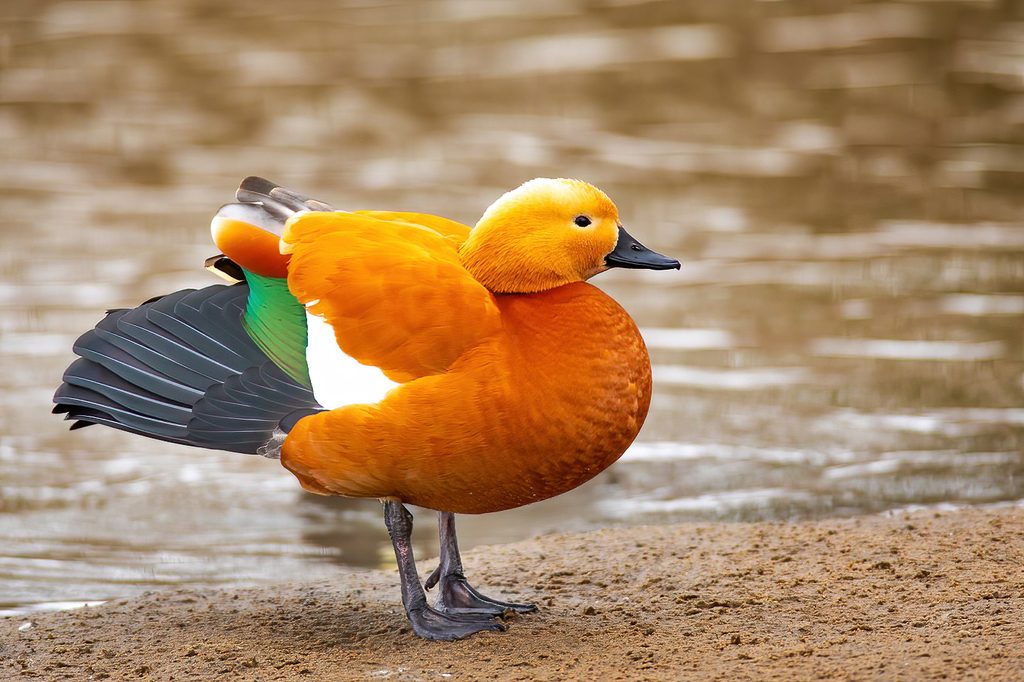
Photo: egorbirder · CC BY 4.0 (May be cropped or resized)
Tadorna ferruginea
U.S. national list: unknown
Basic stats
Diet
Mostly plant material and seeds, with some invertebrates
Habitat
Open inland lakes, reservoirs, rivers, marshes and brackish lagoons
Range
Southeastern Europe and North Africa across central Asia to western China; many eastern birds winter on the Indian subcontinent
Clutch size
About 8 eggs
Incubation period
About 4 weeks
Size
58–70cm
Wingspan
110–135cm
Weight
Averages about 1235g
The Ruddy Shelduck is a distinctive orange-brown waterfowl with a paler head, black flight feathers and tail, and broad white wing coverts that become conspicuous in flight. Breeding males have a narrow black neck ring, while females typically show a whiter face and lack the collar. Its loud nasal calls are often given both in flight and on the ground. Adults measure 58–70 cm, span 110–135 cm and average about 1,235 g (Wikipedia, general species account; AVONET, Tobias et al. 2022).
Across its range, the species breeds from southeastern Europe and small parts of North Africa through central Asia to western China; many eastern birds winter on the Indian subcontinent. It favours open lakes, reservoirs and rivers but also uses marshes and brackish lagoons. Plant material and seeds dominate the diet, with some invertebrates also eaten. Pairs form lasting bonds and nest in cavities that may be far from water. The female incubates about eight eggs for roughly four weeks, while both parents tend the young (Wikipedia, general species account; EltonTraits, Wilman et al. 2014).
Records of Ruddy Shelduck in the USA
This bird's natural range lies outside the USA (AviList v2026), so these are records of wandering, escaped or introduced birds, not places to expect it.
GBIF records grouped by protected area. They show where the species has been reported, not that it is there now, and they are not population counts.
Recorded in 14 protected areas (1979–2024). The 8 with the most records:
- Pointe Mouillee State Game Area: 46 records (2024)
- Great Salt Lake State Park: 15 records (2019–2024)
- Fernhill Wetlands: 9 records (2002)
- Hagerman National Wildlife Refuge: 8 records (1999–2010)
- Chincoteague National Wildlife Refuge: 7 records (1979–1982)
- Erie State Game Area: 6 records (2024)
- San Diego-La Jolla Underwater Park: 6 records (2011–2012)
- Big Island Wildlife Area: 5 records (2009)
Quick answers
- What does the Ruddy Shelduck eat?
- Mostly plant material and seeds, with some invertebrates
- What habitat does the Ruddy Shelduck live in?
- Open inland lakes, reservoirs, rivers, marshes and brackish lagoons
- Where is the Ruddy Shelduck found?
- Southeastern Europe and North Africa across central Asia to western China; many eastern birds winter on the Indian subcontinent
- How many eggs does the Ruddy Shelduck lay?
- About 8 eggs
- How long are the eggs of the Ruddy Shelduck incubated?
- About 4 weeks
- How big is the Ruddy Shelduck?
- 58–70cm
- What is the wingspan of the Ruddy Shelduck?
- 110–135cm
- How much does the Ruddy Shelduck weigh?
- Averages about 1235g