
 Wildlife
of USA
American Pipit
Other Songbirds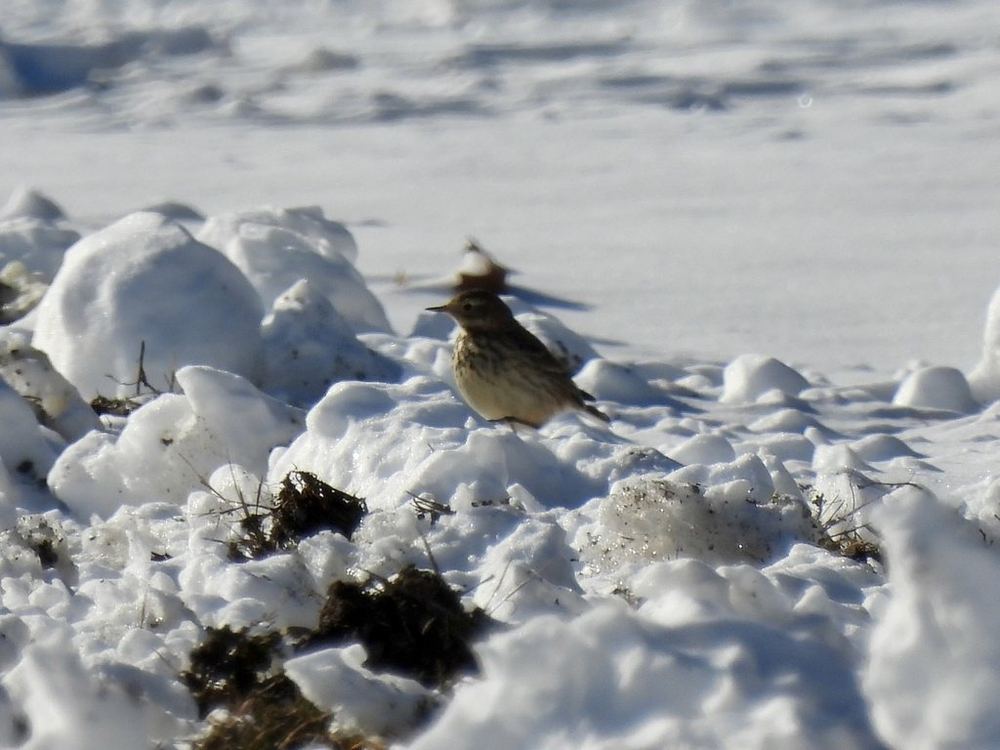
Photo: (c) Caroline Quinn, some rights reserved (CC BY) · CC BY 4.0 (May be cropped or resized)
Anthus rubescens
U.S. national list: unknown
Basic stats
Diet
Mostly invertebrates
Habitat
Tundra, alpine meadows, mudflats and open fields
Range
Breeds in northern and western North America; winters south into Central America
Clutch size
Usually 5 eggs
Incubation period
13–14 days
Weight
Averages about 21g
The American Pipit is a small, ground-dwelling songbird of North America. It walks and feeds in open terrain, often appearing in loose flocks outside breeding periods. AVONET records an average mass of about 21 g and classifies it as a strongly migratory grassland invertivore. Ninety percent of EltonTraits foraging is assigned to ground level (AVONET, Tobias et al. 2022; EltonTraits, Wilman et al. 2014).
The species breeds in northern tundra and western alpine country, then winters south across open fields, shorelines and mudflats into Central America. Arthropods provide its principal food, especially as melting snow exposes prey around nesting territories. A sheltered ground cup in a dry or wet meadow usually holds five eggs. The female incubates for 13–14 days while the male brings food and defends the territory (Wikipedia, general species account; AnAge).
Where to see American Pipit in the USA
GBIF records grouped by protected area. They show where the species has been reported, not that it is there now, and they are not population counts.
Recorded in 3,986 protected areas (1875–2026). The 8 with the most records:
- Monterey Bay National Marine Sanctuary: 8,687 records (1970–2025)
- Greater Farallones National Marine Sanctuary: 7,360 records (1963–2025)
- Rocky Mountain National Park: 6,823 records (1897–2026)
- Southeast Farallon Island State Marine Reserve: 4,817 records (1963–2024)
- Hornsby Bend Ecological Research Area: 4,779 records (1959–2026)
- Point Reyes National Seashore: 4,750 records (1961–2025)
- Yolo Bypass Wildlife Area: 4,336 records (1960–2026)
- Bosque del Apache National Wildlife Refuge: 4,230 records (1976–2025)
Quick answers
- What does the American Pipit eat?
- Mostly invertebrates
- What habitat does the American Pipit live in?
- Tundra, alpine meadows, mudflats and open fields
- Where is the American Pipit found?
- Breeds in northern and western North America; winters south into Central America
- How many eggs does the American Pipit lay?
- Usually 5 eggs
- How long are the eggs of the American Pipit incubated?
- 13–14 days
- How much does the American Pipit weigh?
- Averages about 21g