
 Wildlife
of USA
White-winged Tern
Gulls, Terns & Jaegers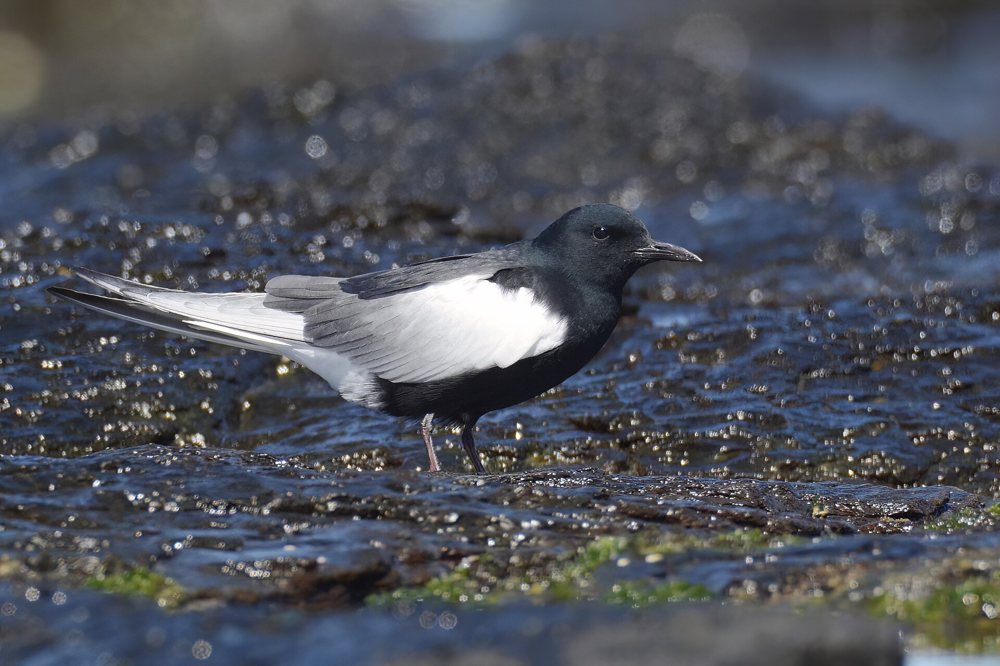
Photo: Nrg800 · CC BY-SA 4.0 (May be cropped or resized)
Chlidonias leucopterus
U.S. national list: unknown
Basic stats
Diet
Mostly insects, with small fish and other small aquatic animals
Habitat
Freshwater marshes, shallow lakes and flooded grasslands when breeding; varied inland and coastal wetlands at other seasons
Range
Breeds from eastern Europe across central Asia; winters mainly in Africa, southern Asia and Australasia
Weight
Averages about 54g
The White-winged Tern is a small marsh tern with long pointed wings and a shallowly forked tail. Breeding adults are strikingly black with contrasting pale wings and a white tail; non-breeding birds become pale grey and white with a dark ear patch. Its quick, light flight is used to pick prey from water or vegetation rather than to make the deep plunges typical of many sea terns. It averages about 54 g (Wikipedia, general species account; AVONET, Tobias et al. 2022).
The species breeds from eastern Europe across central Asia in shallow freshwater marshes, flooded grassland and vegetated lakes. It is strongly migratory, wintering mainly in Africa, southern Asia and Australasia and using both inland wetlands and sheltered coasts during passage. Food consists chiefly of insects, supplemented by small fish and other aquatic animals. Nesting occurs in loose colonies on floating vegetation, where the nest is a platform placed just above the water (Wikipedia, general species account; EltonTraits, Wilman et al. 2014).
Records of White-winged Tern in the USA
This bird's natural range lies outside the USA (AviList v2026), so these are records of wandering, escaped or introduced birds, not places to expect it.
GBIF records grouped by protected area. They show where the species has been reported, not that it is there now, and they are not population counts.
Recorded in 13 protected areas (1963–2023). The 8 with the most records:
- Pointe Mouillee State Game Area: 333 records (2023)
- Chincoteague National Wildlife Refuge: 116 records (1963–2022)
- Little Creek Wildlife Area: 111 records (1973–1993)
- Milford Neck Wildlife Area: 72 records (2022)
- Elkhorn Slough Ecological Reserve: 60 records (1999)
- Bombay Hook National Wildlife Refuge: 55 records (1987–1995)
- Ted Harvey Conservation Area - Logan Lane Tract: 46 records (1988–2008)
- John Heinz National Wildlife Refuge at Tinicum: 45 records (2017)
Quick answers
- What does the White-winged Tern eat?
- Mostly insects, with small fish and other small aquatic animals
- What habitat does the White-winged Tern live in?
- Freshwater marshes, shallow lakes and flooded grasslands when breeding; varied inland and coastal wetlands at other seasons
- Where is the White-winged Tern found?
- Breeds from eastern Europe across central Asia; winters mainly in Africa, southern Asia and Australasia
- How much does the White-winged Tern weigh?
- Averages about 54g