
 Wildlife
of USA
White Ibis
Herons, Ibises & Pelicans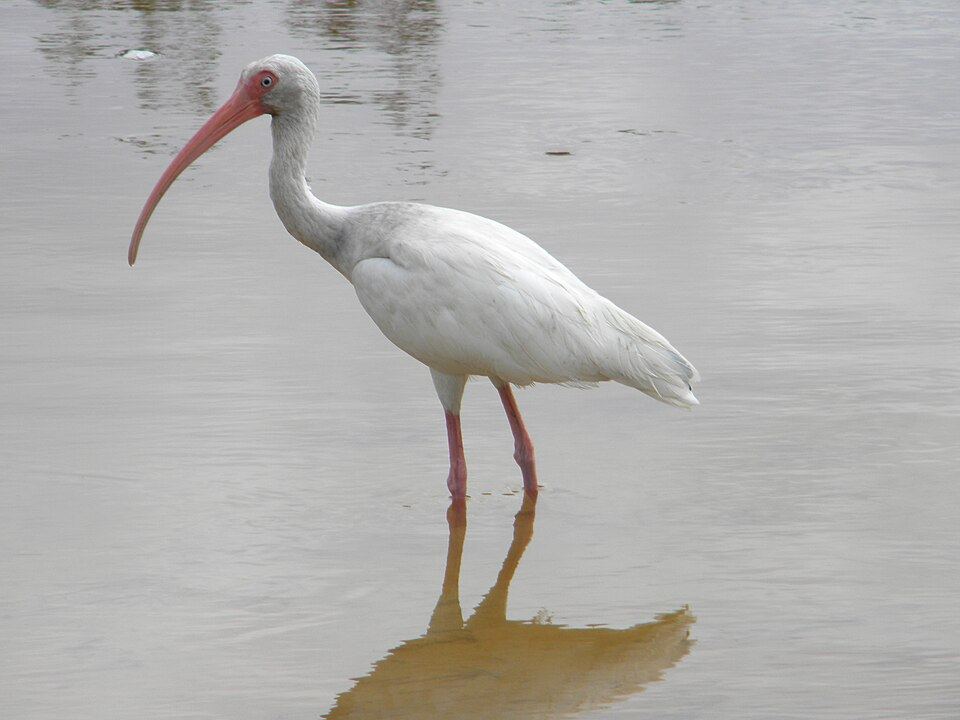
Photo: Maximilian Paradiz from Amsterdam, Netherlands · CC BY 2.0 (May be cropped or resized)
Eudocimus albus
U.S. national list: unknown
Basic stats
Diet
Aquatic prey, especially fish, and invertebrates
Habitat
Freshwater and coastal wetlands
Range
Southeastern United States, Central America, Caribbean and northern South America
Clutch size
3 eggs
Incubation period
22 days
Weight
Averages about 940g
The White Ibis is a large wading bird with white plumage, black wing tips visible in flight, a long downcurved bill, and reddish facial skin and legs in adults. AVONET gives an average mass of about 890 g, while AnAge lists adult weight near 940 g. Its long bill is used while probing wet ground and shallow water, and its broad wings support regular movement among wetland habitats (Wikipedia, general species account; AVONET, Tobias et al. 2022; AnAge).
It uses freshwater marshes, shallow water and coastal wetlands across the southeastern United States, Central America, the Caribbean and northern South America. The diet is dominated by fish according to EltonTraits, with invertebrates also taken; birds commonly forage on foot or probe soft substrates. Nesting is colonial or grouped in wetland vegetation and a typical clutch contains three eggs, incubated for about 22 days (Wikipedia, general species account; EltonTraits, Wilman et al. 2014; AnAge).
Where to see White Ibis in the USA
GBIF records grouped by protected area. They show where the species has been reported, not that it is there now, and they are not population counts.
Recorded in 1,211 protected areas (1880–2026). The 8 with the most records:
- Merritt Island National Wildlife Refuge: 38,325 records (1967–2026)
- Everglades & Dry Tortugas: 30,756 records (1903–2026)
- Florida Keys National Marine Sanctuary: 30,213 records (1925–2026)
- Paynes Prairie: 27,432 records (1978–2026)
- Everglades National Park: 26,429 records (1903–2026)
- JN "Ding" Darling National Wildlife Refuge: 23,704 records (1900–2026)
- Lake Apopka Restoration Area: 23,664 records (1974–2026)
- J.N. "Ding" Darling National Wildlife Refuge: 23,442 records (1900–2026)
Quick answers
- What does the White Ibis eat?
- Aquatic prey, especially fish, and invertebrates
- What habitat does the White Ibis live in?
- Freshwater and coastal wetlands
- Where is the White Ibis found?
- Southeastern United States, Central America, Caribbean and northern South America
- How many eggs does the White Ibis lay?
- 3 eggs
- How long are the eggs of the White Ibis incubated?
- 22 days
- How much does the White Ibis weigh?
- Averages about 940g