
 Wildlife
of USA
Rosy-faced Lovebird
Parrots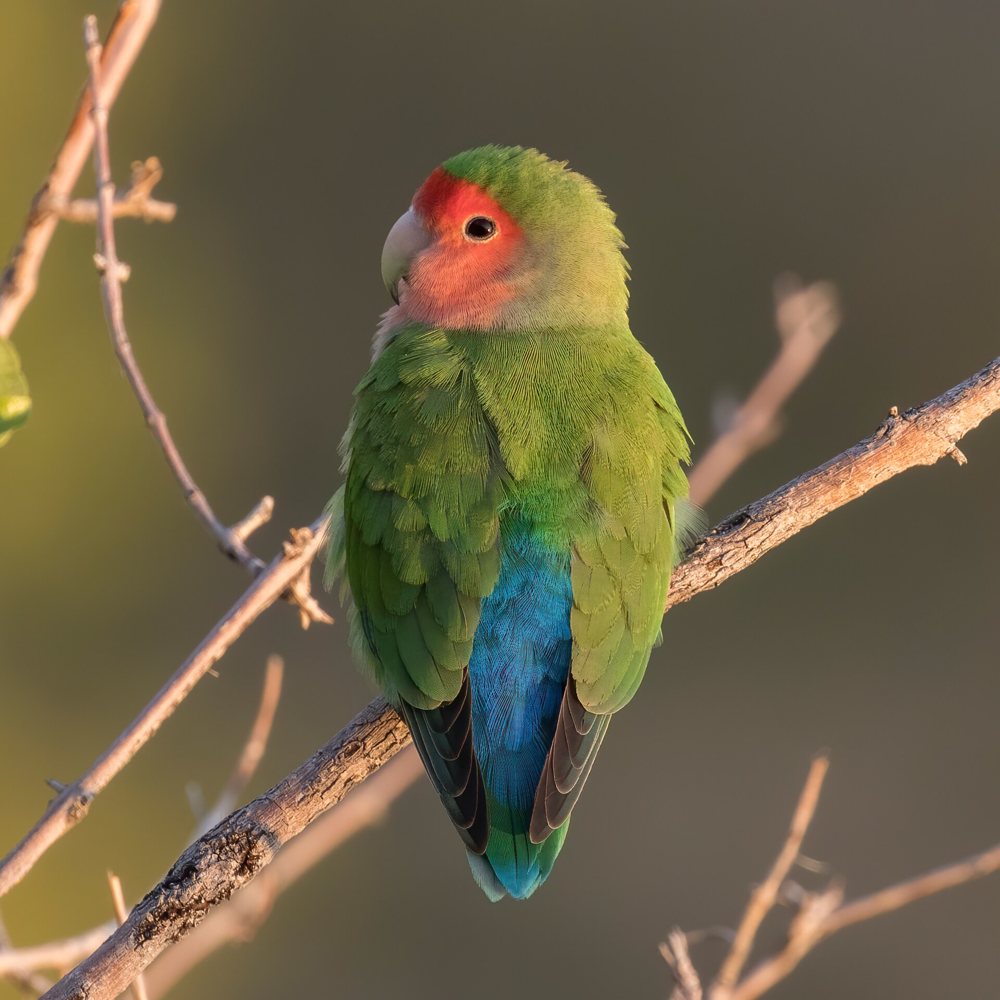
Photo: Charles J. Sharp · CC BY-SA 4.0 (May be cropped or resized)
Agapornis roseicollis
U.S. national list: unknown
Basic stats
Diet
Seeds and other plant material
Habitat
Dry open woodland, semi-desert and mountainous country near water
Range
Southwestern Angola through Namibia to northwestern South Africa
Clutch size
Usually 4–6 eggs
Incubation period
About 23 days
Size
17–18cm
Weight
Averages about 54g
The Rosy-faced Lovebird is a 17–18 cm parrot with mostly green plumage, a blue rump and a pink face and throat, darkest around the forehead and eyes. Males and females look alike, while young birds have a paler face and dark colour at the bill base. AVONET records an average mass of about 54 g, close to the AnAge value (Wikipedia, general species account; AVONET, Tobias et al. 2022; AnAge).
Its native range extends from southwestern Angola across Namibia to northwestern South Africa. Dry open woodland, semi-desert and mountainous country are used, but birds depend on accessible water. Seeds contribute 70% and other plant material 30% to the EltonTraits diet profile. Social flocks may become large around plentiful food. Females carry strips of nesting material into rock crevices, communal weaver nests or buildings, where four to six eggs are incubated for about 23 days (Wikipedia, general species account; EltonTraits, Wilman et al. 2014).
Records of Rosy-faced Lovebird in the USA
This bird's natural range lies outside the USA (AviList v2026), so these are records of wandering, escaped or introduced birds, not places to expect it.
GBIF records grouped by protected area. They show where the species has been reported, not that it is there now, and they are not population counts.
Recorded in 21 protected areas (2003–2026). The 8 with the most records:
- Hawaiian Islands Humpback Whale National Marine Sanctuary: 1,417 records (2010–2026)
- Usery Mountain Regional Park: 387 records (2009–2024)
- Phoenix Mountains Preserve: 216 records (2005–2024)
- Reach 11 Recreation Area: 201 records (2015–2024)
- McDowell Sonoran Preserve: 155 records (2003–2026)
- Keālia Pond National Wildlife Refuge: 114 records (2010–2024)
- South Mountain Park and Preserve: 86 records (2012–2024)
- Tonto National Forest: 54 records (2007–2023)
Quick answers
- What does the Rosy-faced Lovebird eat?
- Seeds and other plant material
- What habitat does the Rosy-faced Lovebird live in?
- Dry open woodland, semi-desert and mountainous country near water
- Where is the Rosy-faced Lovebird found?
- Southwestern Angola through Namibia to northwestern South Africa
- How many eggs does the Rosy-faced Lovebird lay?
- Usually 4–6 eggs
- How long are the eggs of the Rosy-faced Lovebird incubated?
- About 23 days
- How big is the Rosy-faced Lovebird?
- 17–18cm
- How much does the Rosy-faced Lovebird weigh?
- Averages about 54g