
 Wildlife
of USA
Pacific Swift
Nightjars, Frogmouths & Swifts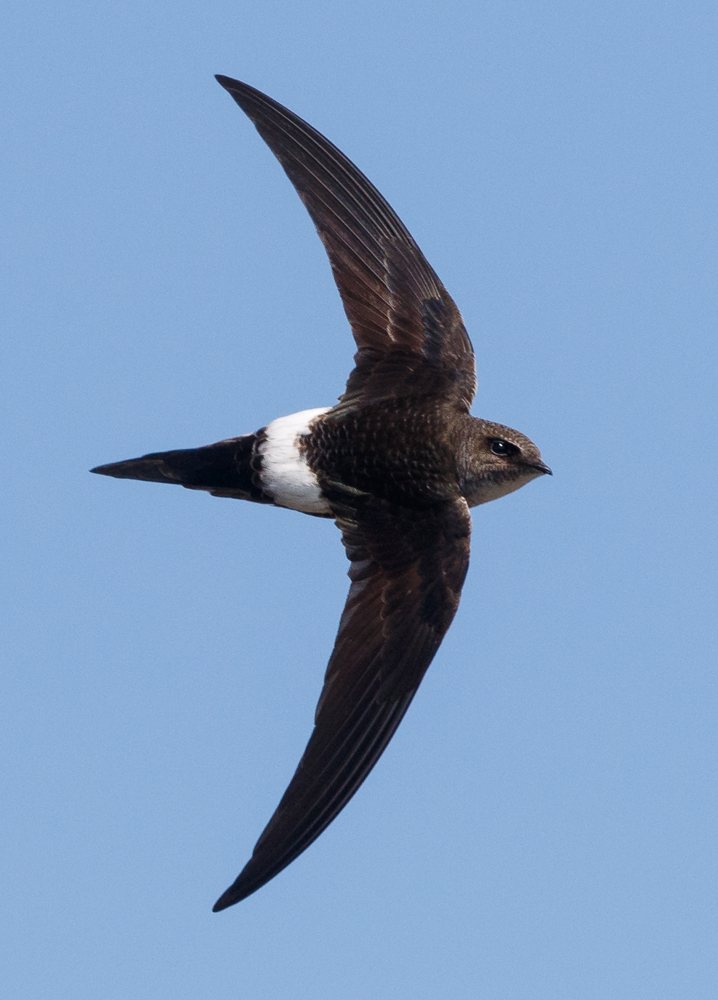
Photo: Stuart Price from Hakodate, Japan · CC BY-SA 2.0 (May be cropped or resized)
Apus pacificus
U.S. national list: unknown
Basic stats
Diet
Flying insects
Habitat
Aerial over woodland, mountains, open ground, towns and coasts
Range
Breeds across eastern Asia; winters in Southeast Asia and Australasia
Size
17–18cm
Weight
Averages about 39g
The Pacific Swift is a dark, sickle-winged swift with a sharply forked tail and a narrow white rump band. Pale feather edges create a scaled effect on the underparts, while the throat is slightly lighter than the rest of the body. Its streamlined form supports rapid, sustained flight, and the species spends most of its time airborne. Average mass is about 39.4 g (Wikipedia, general species account; AVONET, Tobias et al. 2022).
This migrant breeds across eastern Asia from high latitudes into subtropical regions and winters through Southeast Asia and Australasia. It is not tied to one ground habitat, feeding above forests, mountain country, open landscapes, towns and coasts. All food consists of flying insects captured in the air (EltonTraits, Wilman et al. 2014). Nesting occurs in sheltered crevices on cliffs, caves or buildings, depending on local availability (Wikipedia, general species account).
Quick answers
- What does the Pacific Swift eat?
- Flying insects
- What habitat does the Pacific Swift live in?
- Aerial over woodland, mountains, open ground, towns and coasts
- Where is the Pacific Swift found?
- Breeds across eastern Asia; winters in Southeast Asia and Australasia
- How big is the Pacific Swift?
- 17–18cm
- How much does the Pacific Swift weigh?
- Averages about 39g