
 Wildlife
of USA
Magnificent Frigatebird
Seabirds & Alcids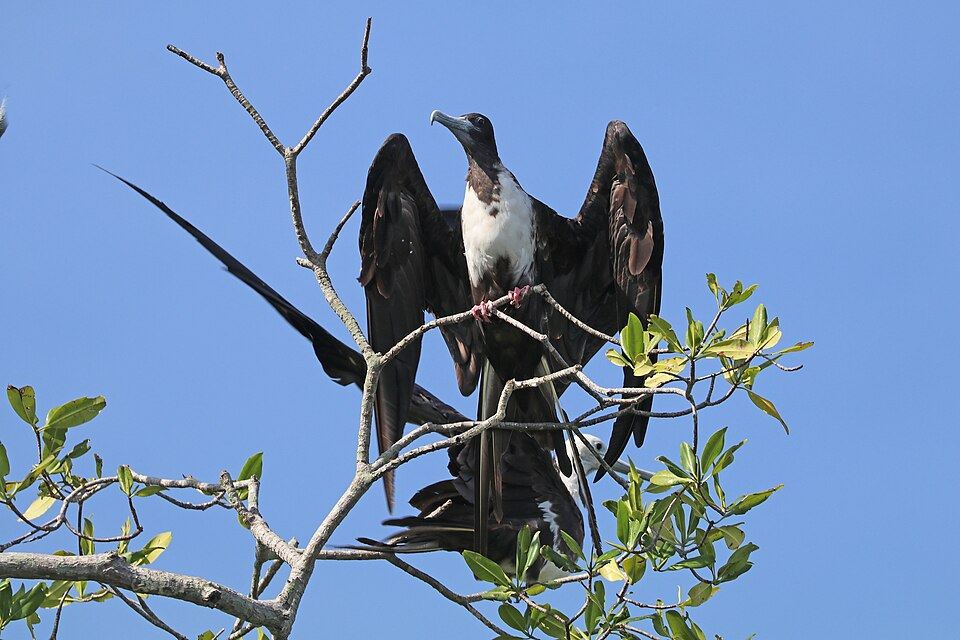
Photo: Charles J. Sharp · CC BY-SA 4.0 (May be cropped or resized)
Fregata magnificens
U.S. national list: unknown
Basic stats
Diet
Mostly fish
Habitat
Tropical and subtropical ocean, coastal islands and mangroves
Range
Tropical Atlantic and Pacific coasts of the Americas, the Caribbean, Galápagos and Cape Verde
Clutch size
1 egg
Incubation period
About 56 days
Size
89–114cm
Wingspan
217–244cm
Weight
Averages about 1491g
The Magnificent Frigatebird is an 89–114 cm seabird with narrow wings spanning 217–244 cm and a deeply forked tail. Males are black with an inflatable red throat sac; larger females have a white breast and belly. AVONET records an average mass of about 1,491 g. The light build supports prolonged soaring, but the birds do not settle on the sea (Wikipedia, general species account; AVONET, Tobias et al. 2022).
It occupies tropical Atlantic and Pacific waters around the Americas, Caribbean, Galápagos and Cape Verde, nesting on coastal islands and in mangroves. Fish contribute 60% to the EltonTraits diet profile. Birds snatch prey near the surface and also pursue other seabirds until they release food. AnAge reports a single egg and an incubation period of about 56 days (Wikipedia, general species account; EltonTraits, Wilman et al. 2014; AnAge).
Where to see Magnificent Frigatebird in the USA
GBIF records grouped by protected area. They show where the species has been reported, not that it is there now, and they are not population counts.
Recorded in 262 protected areas (1860–2026). The 8 with the most records:
- Florida Keys National Marine Sanctuary: 32,803 records (1940–2026)
- Dry Tortugas National Park: 6,303 records (1971–2026)
- JN "Ding" Darling National Wildlife Refuge: 4,550 records (1900–2025)
- J.N. "Ding" Darling National Wildlife Refuge: 4,369 records (1900–2025)
- Curry Hammock State Park: 3,478 records (1964–2024)
- Bill Baggs Cape Florida State Park: 2,728 records (1979–2026)
- Everglades & Dry Tortugas: 2,456 records (1955–2026)
- Long Key State Park: 2,159 records (1972–2024)
Quick answers
- What does the Magnificent Frigatebird eat?
- Mostly fish
- What habitat does the Magnificent Frigatebird live in?
- Tropical and subtropical ocean, coastal islands and mangroves
- Where is the Magnificent Frigatebird found?
- Tropical Atlantic and Pacific coasts of the Americas, the Caribbean, Galápagos and Cape Verde
- How many eggs does the Magnificent Frigatebird lay?
- 1 egg
- How long are the eggs of the Magnificent Frigatebird incubated?
- About 56 days
- How big is the Magnificent Frigatebird?
- 89–114cm
- What is the wingspan of the Magnificent Frigatebird?
- 217–244cm
- How much does the Magnificent Frigatebird weigh?
- Averages about 1491g