
 Wildlife
of USA
House Sparrow
Other Songbirds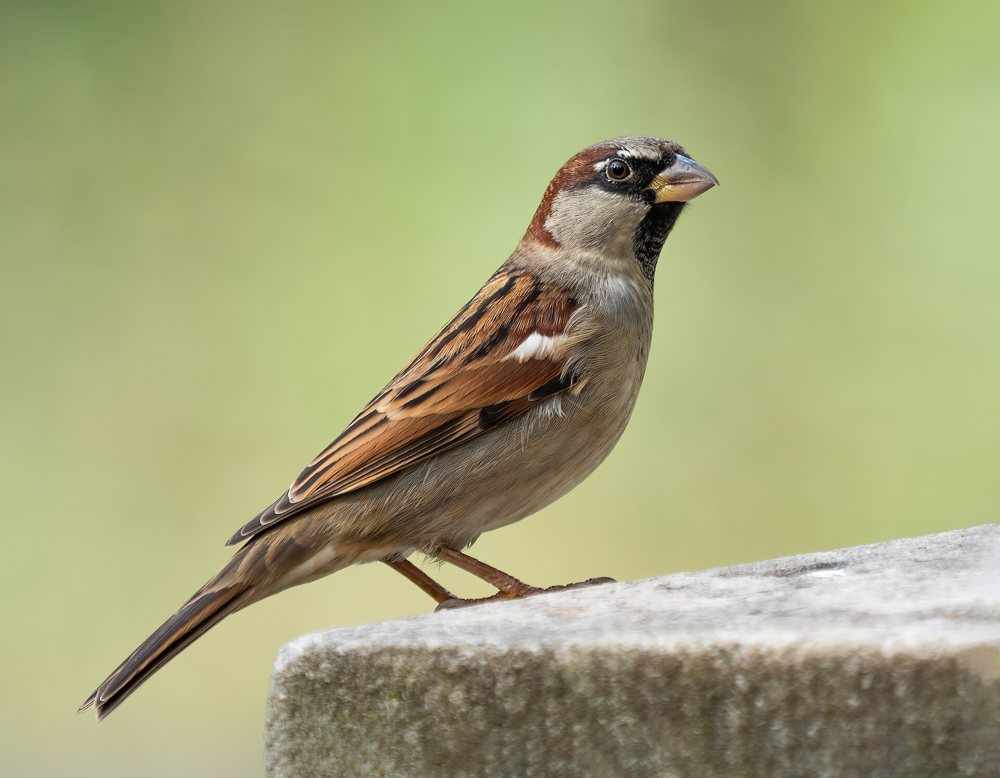
Photo: Rhododendrites · CC BY-SA 4.0 (May be cropped or resized)
Passer domesticus
U.S. national list: unknown
Basic stats
Diet
Mostly seeds and other plant material, with some invertebrates
Habitat
Settlements, farms and other human-modified environments
Range
Native to much of Europe, the Mediterranean and Asia; introduced widely across Africa, the Americas and Australasia
Clutch size
Usually 5 eggs
Incubation period
About 11 days
Size
About 16cm
Weight
Averages about 27g
The House Sparrow is a small, sturdy passerine closely associated with settlements, farms and other human-modified places. Native across much of Europe, the Mediterranean region and Asia, it has been introduced widely in Africa, the Americas and Australasia. Males show stronger black, white and brown patterning, including a dark throat, while females and young birds are plainer brown and grey. Adults are about 16 cm long and commonly weigh 24–39.5 g. (Wikipedia, general species account)
Seeds and other plant material dominate the adult diet, with invertebrates forming a smaller component and becoming particularly important as food for growing young. The birds mostly forage on the ground, often in social groups, and readily use food associated with people. They nest in cavities and sheltered crevices in buildings or other structures. AnAge records a usual clutch of five and incubation of about 11 days; AVONET gives mean mass as about 26.5 g. (EltonTraits, Wilman et al. 2014; AnAge; AVONET, Tobias et al. 2022)
Records of House Sparrow in the USA
This bird's natural range lies outside the USA (AviList v2026), so these are records of wandering, escaped or introduced birds, not places to expect it.
GBIF records grouped by protected area. They show where the species has been reported, not that it is there now, and they are not population counts.
Recorded in 7,737 protected areas (1878–2026). The 8 with the most records:
- National Capital Parks-East: 61,901 records (1954–2026)
- Pinelands National Reserve: 27,009 records (1951–2026)
- George Washington Memorial Parkway: 24,302 records (1964–2026)
- Estero Llano Grande State Park: 23,290 records (1991–2026)
- Gateway National Recreation Area: 22,774 records (1959–2026)
- Jamaica Bay Unit: 21,309 records (1959–2026)
- Coronado National Forest: 17,398 records (1965–2026)
- Cape May Point State Park: 16,964 records (1951–2026)
Quick answers
- What does the House Sparrow eat?
- Mostly seeds and other plant material, with some invertebrates
- What habitat does the House Sparrow live in?
- Settlements, farms and other human-modified environments
- Where is the House Sparrow found?
- Native to much of Europe, the Mediterranean and Asia; introduced widely across Africa, the Americas and Australasia
- How many eggs does the House Sparrow lay?
- Usually 5 eggs
- How long are the eggs of the House Sparrow incubated?
- About 11 days
- How big is the House Sparrow?
- About 16cm
- How much does the House Sparrow weigh?
- Averages about 27g