
 Wildlife
of USA
Arctic Warbler
Warblers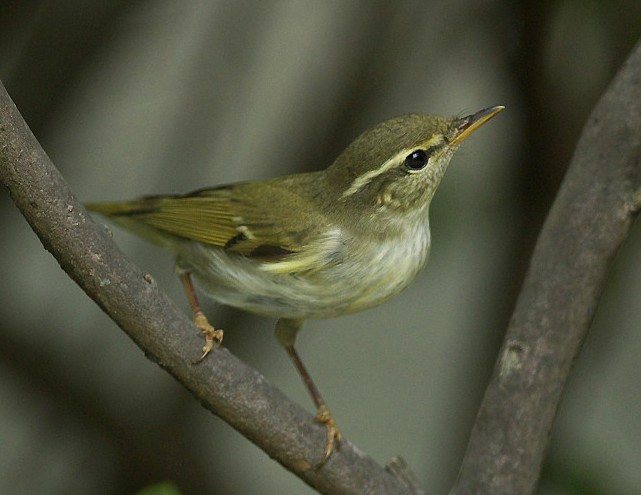
Photo: Arctic_Warbler_4683.jpg : Alnus derivative work: Osado · CC BY-SA 3.0 (May be cropped or resized)
Phylloscopus borealis
U.S. national list: unknown
Basic stats
Diet
Insects and other small invertebrates
Habitat
Birch and mixed woodland, taiga scrub and tundra edge, often near water
Range
Breeds from northern Europe across Siberia to Alaska; winters in Southeast Asia
Clutch size
Averages about 5 eggs
Incubation period
About 12 days
Weight
Averages about 11g
The Arctic Warbler is a small leaf warbler with grey-green upperparts, off-white underparts and a single pale wingbar. A prominent supercilium and relatively heavy, pointed bill help distinguish it from several similar warblers. Its active feeding movements may include rapid dashes through foliage and brief hovering. The species averages about 11 g, and its song is delivered as a quick trill (Wikipedia, general species account; AVONET, Tobias et al. 2022).
Across its range, the species breeds in northern birch or mixed woodland, taiga scrub and vegetation along tundra margins, frequently near water. Its breeding distribution extends from Fennoscandia through Siberia to Alaska. All populations migrate to Southeast Asia for winter. Birds search leaves and branches for insects and other small invertebrates. The nest is placed on the ground within low growth; clutch size averages about five eggs and incubation about 12 days (Wikipedia, general species account; EltonTraits, Wilman et al. 2014; AnAge).
Where to see Arctic Warbler in the USA
GBIF records grouped by protected area. They show where the species has been reported, not that it is there now, and they are not population counts.
Recorded in 31 protected areas (1926–2024). The 8 with the most records:
- Denali National Park: 919 records (1926–2024)
- Denali Wilderness: 830 records (1926–2024)
- Togiak National Wildlife Refuge: 517 records (1995–2021)
- Yukon Delta National Wildlife Refuge: 374 records (1975–2024)
- Delta Wild and Scenic River: 219 records (1994–2024)
- Arctic National Wildlife Refuge: 128 records (1990–2024)
- National Petroleum Reserve–Alaska: 124 records (1951–2024)
- Alaska Maritime National Wildlife Refuge: 86 records (1959–2024)
Quick answers
- What does the Arctic Warbler eat?
- Insects and other small invertebrates
- What habitat does the Arctic Warbler live in?
- Birch and mixed woodland, taiga scrub and tundra edge, often near water
- Where is the Arctic Warbler found?
- Breeds from northern Europe across Siberia to Alaska; winters in Southeast Asia
- How many eggs does the Arctic Warbler lay?
- Averages about 5 eggs
- How long are the eggs of the Arctic Warbler incubated?
- About 12 days
- How much does the Arctic Warbler weigh?
- Averages about 11g